Navigating the Alphabet Soup of AWS Platform Services
AWS can feel like alphabet soup: a sea of three-letter acronyms with no map. A guided survey of core services for enterprise platforms and ETL workflows.
Introduction: When Everything Looks Like Acronyms
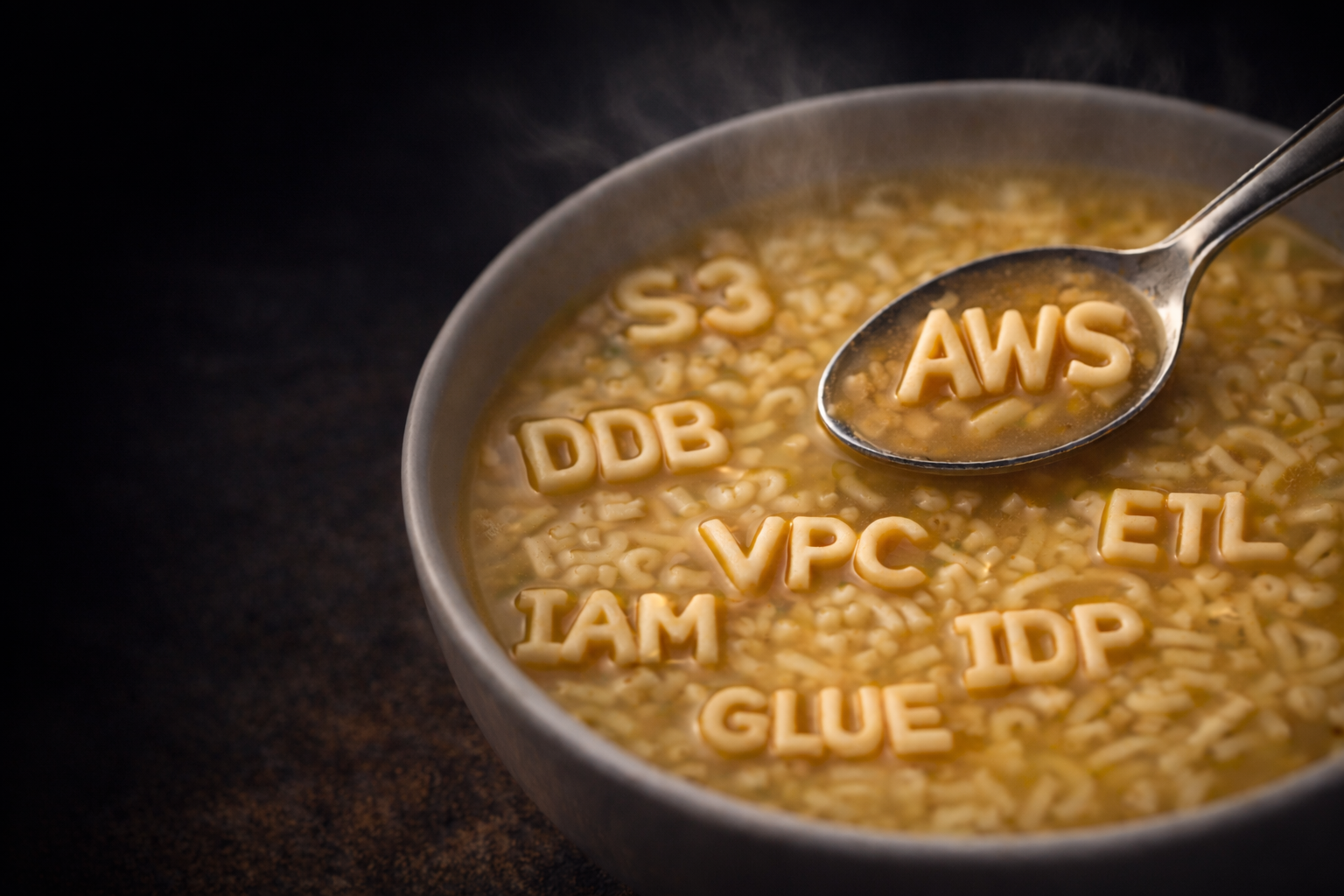
Amazon Web Services can feel like stepping into a bowl of alphabet soup, where every service is reduced to a three-letter acronym and the challenge is not just understanding what each one does, but how they all fit together into a coherent system. IAM, VPC, S3, DDB, Glue, EMR, SQS, SNS — the list grows with every AWS re:Invent keynote, and the surface area of the platform can quickly become paralyzing for engineers, architects, and technical leaders trying to make confident decisions.
This article is not a tutorial. It is a guided survey of the core AWS services used in modern enterprise platforms and ETL workflows, written with the intent of helping you quickly identify the role each service plays in an overall architecture. Think of it as a field guide: broad coverage, honest descriptions, and just enough context to point you toward deeper reading when a service becomes relevant to your work. Whether you are building a greenfield data platform, modernizing a legacy .NET application, or designing a metadata-driven ETL pipeline, this reference should help you navigate the soup with confidence.
The Foundational Layer: Networking, Security, and Identity
Before any workload runs, compute is provisioned, or data moves, AWS requires you to define the boundaries of your environment. These foundational services are the invisible scaffolding that everything else depends on.
VPC — Virtual Private Cloud
The VPC is the isolated network boundary where your AWS resources live. It defines your IP address space, subnets, routing tables, internet gateways, and NAT gateways. Nearly every enterprise workload lives inside a VPC, and understanding how to segment public and private subnets — and how to control traffic between them — is a prerequisite for almost everything else on this list. Think of the VPC as the walls, hallways, and locked doors of your cloud environment.
IAM — Identity and Access Management
IAM governs who and what can access which AWS resources, and under what conditions. It is the backbone of security across the entire platform, expressed through users, groups, roles, and policies written in JSON. In enterprise data platforms, IAM roles are attached to services like Lambda, Glue, and EC2 to define their permissions without embedding credentials. Getting IAM right is one of the most important investments you can make early in platform design — the blast radius of a misconfigured role can be significant.
Route 53
Route 53 is AWS’s managed DNS service, responsible for translating human-readable domain names into IP addresses and routing traffic based on policies like latency, geolocation, or failover. In enterprise architectures, Route 53 is commonly used to manage public-facing domain names, internal service discovery, and health-check-based failover between environments. It also supports DNS-based validation for SSL certificates issued through AWS Certificate Manager.
CloudFront
CloudFront is AWS’s global content delivery network, designed to cache and serve content from edge locations close to the end user. It commonly sits in front of S3-hosted static websites, API Gateway endpoints, or Application Load Balancers. Beyond performance, CloudFront provides security benefits including DDoS protection through AWS Shield and the ability to attach Web Application Firewall rules. For enterprise applications with geographically distributed users, CloudFront is often the first layer of the request path.
AWS Certificate Manager (ACM)
ACM handles the provisioning, renewal, and management of SSL/TLS certificates for use with AWS services like CloudFront, API Gateway, and Elastic Load Balancers. It removes the operational burden of manually tracking certificate expiration and supports both public certificates (for externally facing services) and private certificates (for internal infrastructure). In modern enterprise architectures, ACM is almost always present wherever HTTPS is required.
Compute Layer: Running Your Applications
Once you have a network and an identity model, you need somewhere to run code. AWS offers compute options across a wide spectrum — from raw virtual machines you manage entirely to fully serverless environments where you only think about your function.
EC2 — Elastic Compute Cloud
EC2 is the original AWS workhorse: virtual machines running in the cloud, giving you maximum control over the operating system, runtime, networking, and storage configuration. EC2 is the natural home for lift-and-shift migrations of traditional enterprise applications — think ASP.NET Core apps, Java services, or legacy Windows workloads — where the application assumes a persistent, long-lived server. The tradeoff for control is operational overhead: you are responsible for patching, scaling, and managing the underlying instances.
Auto Scaling Groups
Auto Scaling Groups work alongside EC2 to automatically adjust the number of running instances based on demand metrics like CPU utilization or custom CloudWatch alarms. They are the mechanism that turns a single EC2 instance into a horizontally scalable fleet, and they are foundational to building enterprise applications that handle variable load without manual intervention.
Elastic Load Balancing (ALB / NLB)
AWS offers two primary load balancer types relevant to enterprise workloads. The Application Load Balancer (ALB) operates at the HTTP/HTTPS layer and supports path-based and host-based routing, making it ideal for distributing traffic to web applications and microservices. The Network Load Balancer (NLB) operates at the TCP/UDP layer with ultra-low latency, suited for high-throughput internal services. Load balancers are almost always present in production enterprise architectures, sitting between the internet (or CloudFront) and your compute layer.
ECS — Elastic Container Service
ECS is AWS’s native container orchestration platform, designed to run Docker containers without requiring you to manage a Kubernetes control plane. It supports two launch types: EC2 (where you manage the underlying instances) and Fargate (where AWS manages them for you). ECS is a strong choice for teams that want the portability and consistency of containers without the operational complexity of Kubernetes, and it integrates tightly with other AWS services like IAM, CloudWatch, and Service Connect for internal service discovery.
EKS — Elastic Kubernetes Service
EKS runs a managed Kubernetes control plane on AWS, allowing teams already invested in Kubernetes tooling and workflows to operate in the cloud without self-managing etcd, the API server, or control plane upgrades. It supports both EC2-backed node groups and Fargate-based serverless nodes. EKS is typically the right choice for organizations with significant Kubernetes expertise or multi-cloud portability requirements, though it carries more operational surface area than ECS.
AWS Fargate
Fargate is a serverless compute engine that works with both ECS and EKS, removing the need to provision or manage EC2 instances for container workloads. You define CPU and memory at the task or pod level, and AWS handles the rest. It is particularly well-suited for ETL jobs, batch workloads, and API services where per-task compute isolation is desirable and always-on infrastructure is wasteful.
Lambda — Serverless Functions
Lambda is AWS’s event-driven, serverless compute service. You upload code (Python, Node.js, Java, Go, and others), define the trigger (an API Gateway request, an S3 upload, an SQS message, a scheduled EventBridge rule), and AWS handles everything else — scaling, patching, and execution. Lambda is an ideal fit for lightweight ETL steps, API backends, event processors, and glue code that connects services together. Its limitations — cold starts, execution time limits, and statelessness — make it a poor fit for long-running or memory-intensive workloads, where ECS or Glue are better alternatives.
Elastic Beanstalk
Elastic Beanstalk is a platform-as-a-service layer on top of EC2, designed to simplify the deployment of web applications by abstracting away infrastructure management. You provide application code and a configuration, and Beanstalk handles provisioning EC2 instances, load balancers, and auto scaling groups. It is a pragmatic choice for teams that want to deploy traditional web apps quickly without building out full infrastructure-as-code pipelines, though it offers less flexibility than managing ECS or EC2 directly.
AWS App Runner
App Runner is a newer, more opinionated service for deploying containerized web applications and APIs with minimal configuration. It automatically handles build, deploy, scaling, and load balancing from a container image or source code repository. App Runner is best suited for straightforward web services where operational simplicity outweighs the need for fine-grained infrastructure control.
Data Storage Layer: From Files to Databases
Enterprise platforms almost always involve multiple storage technologies simultaneously, each optimized for a different access pattern. AWS provides a deep catalog of storage options ranging from raw object storage to fully managed relational engines.
S3 — Simple Storage Service
S3 is the backbone of virtually every AWS data architecture. It stores objects — files, documents, data files, logs, model artifacts, static web assets — in a flat namespace organized into buckets, with virtually unlimited capacity and eleven nines of durability. In ETL pipelines, S3 typically serves as the raw landing zone (Bronze layer), the transformed staging area (Silver layer), and sometimes the curated output (Gold layer) before data reaches a warehouse. Its integration surface is enormous: nearly every AWS service can read from or write to S3, making it the natural lingua franca of cloud data platforms.
EFS — Elastic File System
EFS provides a managed, scalable NFS file system that can be mounted concurrently across multiple EC2 instances or ECS tasks. It is designed for workloads that require shared file access — a pattern common in applications migrating from on-premises architectures that relied on UNC file paths or network shares. EFS is often used in hybrid modernization patterns where a legacy application still expects a file system interface while surrounding services are being rewritten.
FSx
FSx is a family of managed file system services optimized for specific use cases. FSx for Windows File Server provides a fully managed Windows-native file system with SMB protocol support, Active Directory integration, and NTFS semantics — making it the natural landing spot for Windows-based enterprise applications that require shared storage. FSx for Lustre is a high-performance file system designed for compute-intensive workloads like machine learning training or high-performance computing jobs.
RDS — Relational Database Service
RDS provides managed relational databases for PostgreSQL, MySQL, MariaDB, Oracle, and SQL Server. AWS handles provisioning, patching, backups, and Multi-AZ failover, leaving you to manage schema design and query optimization. RDS is the right choice for enterprise applications with transactional workloads, complex joins, and existing SQL-based business logic. It is the managed equivalent of the traditional on-premises database server, without the infrastructure overhead.
Aurora
Aurora is AWS’s proprietary cloud-native relational database engine, compatible with both PostgreSQL and MySQL but architected from the ground up for cloud scale. It separates compute from storage, replicates data across multiple availability zones automatically, and supports features like Aurora Serverless (which scales compute capacity up and down based on demand) and Aurora Global Database (which provides cross-region replication). For net-new enterprise applications requiring a relational database, Aurora often offers better performance and availability characteristics than standard RDS at a comparable price point.
DynamoDB (DDB)
DynamoDB is AWS’s fully managed, serverless NoSQL key-value and document database, designed for single-digit millisecond latency at any scale. It is schema-flexible, highly available across multiple availability zones, and integrates natively with Lambda, Step Functions, and Streams. In data platform architectures, DynamoDB excels as a metadata store — tracking ETL job configurations, client-specific schema versions, workflow state, and processing history. Its access patterns must be thought through carefully at design time, as DynamoDB’s performance is tightly coupled to how data is partitioned and queried.
ElastiCache
ElastiCache provides managed in-memory caching via Redis or Memcached, designed to reduce database load and accelerate read-heavy workloads. It is commonly placed in front of RDS or DynamoDB to cache frequently accessed data — session tokens, reference data, API responses — at sub-millisecond latency. In enterprise platforms, ElastiCache often appears in architectures where API response time is a critical requirement and the underlying data changes infrequently.
ETL & Data Processing Layer
The data processing layer is where raw data is cleaned, transformed, validated, and made useful. AWS provides a spectrum of tools here, from fully serverless options to big-data cluster management, and the right choice depends heavily on data volume, transformation complexity, and team expertise.
AWS Glue
Glue is AWS’s serverless ETL service and one of the most commonly encountered services in modern data platform architectures. It provides a managed Apache Spark environment for running PySpark or Scala transformation jobs without provisioning or managing clusters. Beyond job execution, Glue includes a Data Catalog — a centralized metadata repository that tracks tables, schemas, and partitions across S3, Redshift, RDS, and other sources. The Data Catalog integrates with Athena, Redshift Spectrum, and Lake Formation, making it a foundational piece of a well-organized data lake strategy. Glue Crawlers can automatically infer schema from raw S3 data, reducing the manual overhead of catalog management.
EMR — Elastic MapReduce
EMR provisions and manages clusters of EC2 instances running big data frameworks like Apache Spark, Hadoop, Hive, and Presto. Unlike Glue, which abstracts the cluster entirely, EMR gives you direct access to the cluster — allowing fine-grained control over instance types, Spark configuration, and framework versions. EMR is the right choice for workloads that require the full Spark ecosystem, custom libraries not supported by Glue, or processing volumes that benefit from persistent cluster optimization. EMR Serverless, a newer variant, removes cluster management overhead while retaining deeper configurability than Glue.
Step Functions
Step Functions is AWS’s serverless workflow orchestration service, based on a state machine model defined in Amazon States Language (ASL). It coordinates multi-step ETL pipelines, approval workflows, retry logic, and parallel execution branches without requiring you to write orchestration code. Step Functions integrates natively with Lambda, Glue, ECS, SNS, SQS, and DynamoDB, making it a natural choice for orchestrating complex, multi-service data workflows. Its visual workflow editor in the AWS Console makes execution tracing and debugging significantly easier than custom orchestration code.
Amazon MWAA — Managed Workflows for Apache Airflow
MWAA provides a managed environment for running Apache Airflow, the open-source DAG-based workflow orchestration platform widely used in the data engineering community. It is the right choice for teams with existing Airflow expertise or complex inter-dependency graphs that benefit from Airflow’s rich operator ecosystem and community integrations. MWAA handles Airflow’s infrastructure, scaling, and version management, though it carries more operational overhead than Step Functions for teams without prior Airflow investment.
Kinesis Data Streams
Kinesis Data Streams is a real-time data streaming service designed for ingesting high-throughput event data — clickstreams, application logs, IoT telemetry, financial transactions — and making it available for processing with sub-second latency. It is the AWS-native alternative to Apache Kafka for streaming ingestion, and it integrates directly with Lambda (for serverless stream processing), Kinesis Data Firehose (for delivery to S3 or Redshift), and Kinesis Data Analytics (for SQL or Apache Flink-based stream processing). For enterprise platforms that need real-time visibility into operational data, Kinesis is typically the entry point.
Kinesis Data Firehose
Firehose is a fully managed delivery service that sits downstream of Kinesis Data Streams or other producers, automatically batching and delivering data to destinations like S3, Redshift, OpenSearch, or third-party SIEM tools. Unlike Kinesis Data Streams, Firehose requires no consumer application code — it handles buffering, compression, format conversion (including Parquet and ORC transformation), and delivery automatically. It is a common component in streaming-to-data-lake pipelines where near-real-time S3 delivery is the goal.
AWS Batch
AWS Batch is a fully managed service for running large-scale batch computing workloads on EC2 or Fargate. It dynamically provisions compute capacity based on the volume and resource requirements of submitted jobs, making it well-suited for ETL workloads, scientific computing, financial modeling, and any job that is compute-intensive, parallelizable, and not latency-sensitive. Unlike Lambda (which has time and memory limits) and Glue (which is Spark-specific), Batch supports arbitrary containerized workloads with flexible compute configurations.
Analytics, Data Warehousing, and BI
Once data has been transformed and curated, it needs to be made queryable and presentable. This layer of the stack is where analytical workloads, business intelligence, and reporting live.
Redshift
Redshift is AWS’s managed columnar data warehouse, optimized for large-scale analytical queries across structured data. It supports standard SQL, integrates with a wide range of BI tools, and can query data directly in S3 via Redshift Spectrum without loading it into the warehouse. In Bronze/Silver/Gold ETL architectures, Redshift typically serves as the Gold layer — the curated, query-optimized destination where business intelligence tools like Power BI connect and report. Redshift Serverless, a newer option, removes the need to manage cluster sizing and provides a consumption-based pricing model suited for intermittent or unpredictable workloads.
Athena
Athena is a serverless, interactive query service that runs SQL directly against data stored in S3, using the Glue Data Catalog for schema information. There is no infrastructure to provision — you pay per query based on the amount of data scanned, making it ideal for ad hoc analysis, exploratory data work, and lightweight reporting pipelines. Athena is frequently used alongside Glue as a low-friction way to validate transformations, audit data quality, or provide SQL access to raw data lake content without loading it into a warehouse. Columnar formats like Parquet and ORC dramatically reduce query cost and improve performance.
Lake Formation
Lake Formation is a governance and access control layer built on top of S3, Glue, and Athena. It provides a centralized place to define fine-grained data access policies — column-level security, row-level filtering, and tag-based permissions — enforced consistently across Athena, Redshift Spectrum, and EMR. For enterprise platforms with complex data sharing requirements or regulatory compliance obligations, Lake Formation provides the control plane that makes a data lake safely shareable across teams and personas.
OpenSearch Service (formerly Elasticsearch)
OpenSearch is a managed search and analytics engine derived from Elasticsearch, designed for full-text search, log analytics, and observability use cases. In enterprise architectures, it commonly appears as the backend for application search features, as a log aggregation and analysis platform (often receiving data from Kinesis Firehose), or as an operational metrics store. Its Kibana-compatible dashboard interface makes it accessible to non-engineering stakeholders who need to explore log and event data.
QuickSight
QuickSight is AWS’s native business intelligence and data visualization service, supporting connections to Redshift, Athena, S3, RDS, and a range of third-party sources. It provides an in-browser dashboard authoring experience with built-in ML-powered insights like anomaly detection and forecasting. QuickSight’s SPICE in-memory engine accelerates query performance for interactive dashboards. While many enterprise organizations use third-party BI tools like Power BI or Tableau, QuickSight is worth understanding as an AWS-native option, particularly in architectures where all data assets already live in the AWS ecosystem.
Application Integration & Event-Driven Architecture
Modern enterprise platforms rarely consist of a single monolithic application. They are composed of loosely coupled services that communicate through events, messages, and APIs. AWS provides a rich set of services for building these integration patterns.
API Gateway
API Gateway is the managed service for creating, publishing, securing, and monitoring RESTful and WebSocket APIs on AWS. It handles traffic management, authorization (via IAM, Lambda authorizers, or Amazon Cognito), throttling, caching, and request/response transformation. API Gateway is almost always paired with Lambda or ECS as the API layer for serverless and containerized backends. It also supports direct service integrations — allowing API Gateway to invoke Step Functions, write to DynamoDB, or publish to SQS without a Lambda intermediary — which can significantly reduce latency and operational complexity in well-defined workflows.
EventBridge
EventBridge is a serverless event bus that enables decoupled, event-driven architectures by routing events from AWS services, custom applications, or third-party SaaS providers to target services like Lambda, Step Functions, SQS, or ECS tasks. It is the evolution of CloudWatch Events and supports sophisticated event pattern matching, schema registry, and cross-account event delivery. EventBridge is the right integration mechanism when you want services to react to state changes — a file landing in S3, a DynamoDB item changing, a Salesforce record updating — without creating direct dependencies between producers and consumers.
SQS — Simple Queue Service
SQS provides managed message queuing for decoupling producers and consumers in distributed systems. It guarantees at-least-once message delivery and supports two queue types: Standard (high throughput, best-effort ordering) and FIFO (exactly-once processing, strict ordering). In ETL architectures, SQS is commonly used to buffer work between pipeline stages — for example, queuing file processing jobs triggered by S3 uploads, or managing retry logic for Power BI refresh requests. Dead-letter queues (DLQs) allow failed messages to be isolated for inspection without losing them.
SNS — Simple Notification Service
SNS is a managed pub/sub messaging service that broadcasts messages to multiple subscribers simultaneously. A single SNS topic can fan out to SQS queues, Lambda functions, HTTP endpoints, and email addresses in parallel, making it a powerful mechanism for triggering downstream reactions to a single event. SNS and SQS are frequently used together: SNS for broadcast delivery, SQS for reliable, individually consumed work queues. This fan-out pattern is common in notification systems, data pipeline triggers, and audit logging architectures.
AppSync
AppSync is AWS’s managed GraphQL service, enabling clients to query and mutate data across multiple backends through a single, unified GraphQL endpoint. It supports real-time data subscriptions via WebSocket and integrates with DynamoDB, Lambda, RDS, and HTTP endpoints as data sources. AppSync is well-suited for applications with complex, client-driven data requirements — mobile backends, collaborative tools, or dashboards that need to aggregate data from multiple sources in a single request.
Amazon Cognito
Cognito provides user authentication, authorization, and user management for web and mobile applications. It supports user pools (for sign-up, sign-in, and identity management) and identity pools (for granting temporary AWS credentials to authenticated users). Cognito integrates with social identity providers (Google, Apple, Facebook) and enterprise identity providers via SAML and OIDC. In enterprise platforms, Cognito is commonly used as the authentication layer for internal tools and APIs, with API Gateway enforcing Cognito-issued JWT tokens for access control.
DevOps, Monitoring, and Observability
Deploying software to AWS is only the beginning. Running it reliably at scale requires continuous visibility into system health, automated delivery pipelines, and the ability to respond to incidents quickly.
CloudWatch
CloudWatch is AWS’s centralized observability platform for logs, metrics, and alarms. Every AWS service emits metrics and logs to CloudWatch by default, and custom application metrics and log groups can be created programmatically. CloudWatch Alarms trigger notifications or automated actions when metrics cross defined thresholds, while CloudWatch Dashboards provide at-a-glance visibility into system health. CloudWatch Logs Insights provides a query interface for exploring log data at scale. For most enterprise platforms, CloudWatch is the first stop in any investigation.
CloudTrail
CloudTrail records every API call made to your AWS account — who made it, from where, when, and what parameters were passed. It is the audit log of your cloud environment, essential for security investigations, compliance reporting, and change tracking. CloudTrail logs can be delivered to S3 for long-term retention and queried with Athena, or streamed to CloudWatch Logs for near-real-time alerting on sensitive operations like IAM policy changes or root account usage.
AWS X-Ray
X-Ray provides distributed tracing for applications running on Lambda, ECS, EC2, and API Gateway, allowing you to visualize request flows across service boundaries and identify performance bottlenecks or error sources. It produces service maps that show how requests travel through your architecture, making it significantly easier to diagnose latency issues in complex microservice or serverless systems. X-Ray is most valuable in architectures where a single user request triggers multiple downstream service calls.
CodePipeline / CodeBuild / CodeDeploy
AWS’s native CI/CD toolchain covers the full software delivery lifecycle. CodePipeline orchestrates multi-stage delivery workflows — source, build, test, deploy — triggered by repository changes. CodeBuild provides a managed build environment that compiles code, runs tests, and produces deployment artifacts. CodeDeploy automates the deployment of application artifacts to EC2, ECS, Lambda, or on-premises targets with configurable deployment strategies including blue/green and canary rollouts. Together, they provide a fully AWS-native continuous delivery capability without requiring third-party tooling.
AWS CDK — Cloud Development Kit
The CDK is an infrastructure-as-code framework that allows you to define AWS resources using familiar programming languages — TypeScript, Python, Java, and others — rather than raw CloudFormation templates. CDK constructs abstract common infrastructure patterns into reusable components, and the framework compiles down to CloudFormation for deployment. For teams building complex, multi-service platforms on AWS, CDK dramatically improves the expressiveness, testability, and reusability of infrastructure definitions compared to managing CloudFormation YAML directly.
Systems Manager (SSM)
Systems Manager provides operational tooling for managing EC2 instances and on-premises servers at scale — including patch management, run command execution, session manager (browser-based shell access without SSH), parameter store (for configuration and secrets), and inventory. In enterprise architectures, SSM Parameter Store is a lightweight but powerful mechanism for storing environment-specific configuration values and non-sensitive secrets that Lambda functions, ECS tasks, and EC2 instances can retrieve at runtime.
AWS Secrets Manager
Secrets Manager provides secure storage, rotation, and retrieval of sensitive credentials — database passwords, API keys, OAuth tokens. Unlike SSM Parameter Store, Secrets Manager supports automatic secret rotation via Lambda functions and is specifically designed for secrets that require lifecycle management. It integrates natively with RDS, Redshift, and other AWS services to enable seamless credential rotation without application downtime.
Enterprise Application Patterns
Understanding individual services is necessary but not sufficient. Enterprise architectures emerge from the intentional combination of these services into patterns that solve real business problems. The following are the most common patterns encountered in enterprise AWS deployments.
Traditional Web Application Hosting
Enterprise web applications — including ASP.NET Core systems, Java Spring Boot services, or Node.js APIs — typically run on EC2 or ECS behind an Application Load Balancer, with Route 53 directing traffic and CloudFront optionally providing edge caching and SSL termination. The application tier connects to RDS or Aurora for transactional data and S3 for file storage. Auto Scaling Groups ensure the compute layer expands and contracts with demand. This pattern is the cloud-native equivalent of the traditional three-tier architecture, and it remains the most common enterprise hosting model on AWS.
Metadata-Driven ETL Pipelines
A sophisticated pattern used in multi-client data platforms involves storing ETL configuration and schema definitions in DynamoDB, using those metadata records to dynamically drive Glue job behavior, staging transformed data through S3 Bronze/Silver layers, and loading curated Gold-layer data into Redshift for BI consumption. Step Functions orchestrate the overall workflow, Lambda handles lightweight preprocessing and notification, and SQS buffers work between stages. This architecture scales horizontally — adding a new client or data schema requires a metadata record, not a code change — and is well-suited to SaaS data platforms serving many customers with similar but distinct data shapes.
Hybrid File and Cloud Storage Migration
Applications transitioning from on-premises UNC file path architectures to cloud-native storage often use a bridging pattern: EFS or FSx for Windows File Server provides the familiar file system interface that existing application code expects, while a parallel Glue pipeline processes files arriving in S3 for downstream analytics. Over time, the file system dependency is eliminated as application components are rewritten to interact with S3 directly. This incremental modernization pattern reduces the risk of a full rewrite while progressively moving workloads toward cloud-native architectures.
Event-Driven Microservices
Decoupled service architectures use EventBridge as the central event bus, with individual services publishing events when their state changes and subscribing only to the events relevant to their function. SQS queues absorb bursts of work and provide resilience against downstream unavailability. Lambda or ECS services process messages and publish further events. API Gateway exposes synchronous interfaces for request/response interactions where real-time results are required. This architecture enables independent deployment and scaling of individual services, but requires investment in event schema design, dead-letter queue monitoring, and idempotency handling.
Serverless API Backends
A common pattern for internal tools and lightweight public APIs uses API Gateway as the front door, Lambda as the compute layer, DynamoDB as the primary data store, and Cognito for authentication. This stack requires no persistent infrastructure, scales automatically from zero to high load, and incurs no cost when idle. It is particularly well-suited to internal tools, low-traffic APIs, and applications with variable or unpredictable usage patterns. The operational simplicity of this stack comes at the cost of cold start latency and the architectural constraints of DynamoDB’s access pattern model.
Choosing the Right Ingredients
Serverless vs. Managed vs. Self-Managed
AWS services exist across a spectrum from fully self-managed (EC2, EKS with self-managed nodes) to fully serverless (Lambda, DynamoDB, Athena, Fargate). The tradeoffs are consistent across the spectrum: more control typically means more operational overhead, while more managed services typically mean less flexibility but faster time to value. The right answer is usually a blend — serverless for event-driven and variable workloads, managed services for stateful databases and message queues, and EC2 or EKS for workloads that require specific runtime configurations or sustained compute.
Cost Architecture Matters
Every AWS service has a different cost model — some are priced by compute time, others by data volume scanned, stored, or transferred, and others by request count. Architectural decisions that seem equivalent from a capability perspective can differ dramatically in cost at scale. Athena queries that scan unpartitioned S3 data, DynamoDB tables without appropriate read/write capacity planning, and NAT Gateway egress charges are among the most common sources of unexpected AWS costs in enterprise platforms. Understanding the billing model of each service is as important as understanding its functional role.
Right-Sizing Is Iterative
No architecture is designed perfectly from the start. AWS’s breadth of services is an advantage precisely because it allows architectures to evolve: Lambda functions can be replaced by ECS tasks when workloads outgrow function limits, DynamoDB tables can be moved to Aurora when relational access patterns emerge, and Glue jobs can be migrated to EMR when transformation complexity exceeds what Glue’s managed Spark environment supports. Building with migration paths in mind — and avoiding unnecessary lock-in at the seams between services — is one of the hallmarks of a mature enterprise AWS architecture.
Conclusion: From Soup to Strategy
What initially looks like a bowl of alphabet soup — a chaotic mixture of three-letter acronyms floating in a sea of documentation — resolves into a coherent set of building blocks once you understand the role each service plays in a larger system. VPC and IAM define the boundaries and access rules. EC2, ECS, Lambda, and Fargate provide compute across the control spectrum. S3, RDS, DynamoDB, and Redshift store different shapes of data for different purposes. Glue, Step Functions, Kinesis, and Batch move and transform that data. API Gateway, SQS, SNS, and EventBridge connect services without creating fragile dependencies. And CloudWatch, CloudTrail, and the CDK keep everything observable, auditable, and reproducible.
None of these services exist in isolation, and understanding them in context — as participants in an architecture, not as features in a catalog — is what separates an engineer who can navigate AWS confidently from one who is still reaching for the dictionary. The soup is complex, but the recipe makes sense once you know what you are cooking.
This article is part of a broader series on enterprise data architecture and cloud platform engineering. For deeper dives into any of the services or patterns described here, see the linked references or reach out directly.