Digital Transformation Is Just Change Management With a Bigger Budget
I logged 220 senior tech job postings during a search. The pattern that emerged isn't about technology at all.
I’ve spent the last several months tracking every senior technology role I’ve looked at, seriously or in passing, in a database: 220 postings and counting, from VP and Director titles to Principal and Staff IC roles, across industries from higher ed to pharma to fintech to quick-service restaurants. I wasn’t building this to write an essay. I was building it to stay organized during a job search. But once you log 220 of anything with the same eye, patterns show up whether you’re looking for them or not.
Here’s the one I can’t stop seeing: the roles that say “Digital Transformation” and the roles that actually need change management are, more often than not, the same role. Companies just won’t call it that.
What “Digital Transformation” is actually asking for
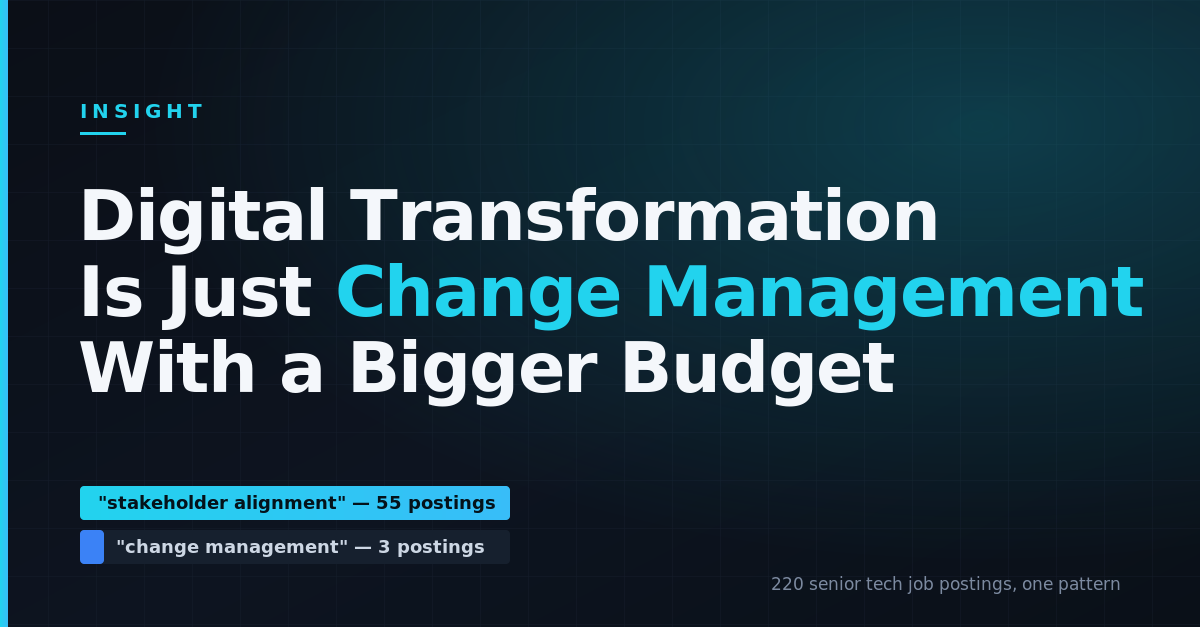
Pull the requirements out of almost any senior technology posting with “Transformation,” “Modernization,” or “Platform” in the title, and a large share of the substance isn’t technical. It’s organizational. Stakeholder alignment shows up in 55 of the 220 postings I’ve logged. Governance shows up in 51. Transformation itself, as a stated responsibility rather than a title word, in 26. “Adoption,” as in getting people to actually use the thing, in 18.
Compare that to the literal phrase “change management.” It appears three times. Three, out of 220.
That gap is the whole essay.
Companies aren’t hiding the work. It’s right there in the bullet points. They’re hiding the name for it. A Robert Half posting for an “AI Engineer” doesn’t ask for change management experience, it asks for an “AI champions network” and “change enablement.” A Capital One product manager posting doesn’t say “drive organizational buy-in,” it says “drive adoption of development tools.” A McDonald’s “Director, Transformation” role wants someone who can “translate business priorities into engineering roadmaps” and hold “executive partnership and influence,” phrasing that describes a political operator as much as a technologist. Even a college CIO posting that uses the actual phrase “digital transformation” in its title pairs it, three lines later, with “stakeholder collaboration (faculty, staff, students),” which is the same work Enrollment Management has been doing under a duller name for twenty years.
None of this is a criticism of any single company. It’s a pattern that shows up everywhere I look, from a dental instrument manufacturer to a Fortune 500 quick-service chain to a graduate research faculty appointment. It’s structural, not a one-off.
Why the euphemism exists
“Change Management” has a branding problem. Say it in a board meeting and it sounds like a line item: training budgets, town halls, a consultant with a slide deck about “the change curve.” It sounds like overhead. It sounds like an admission that something inside the company is broken enough to need managing.
“Digital Transformation” sounds like the opposite. It sounds like an investment. It goes on the same slide as AI, cloud migration, and modernization, three words boards currently love funding. It promises a deliverable: a new platform, a new stack, a vendor contract with a start and end date. Nobody gets excited approving a budget to fix how Product and Finance argue about whose numbers are correct. Plenty of people get excited approving a budget for “our AI transformation.”
So the work doesn’t disappear. It gets relabeled and attached to a technology initiative that can carry it. The org chart still needs someone who can get fifteen-year incumbents to give up a workflow they built and defended, still needs someone who can settle a metric-ownership fight between two VPs, still needs someone who can make three departments agree to a single source of truth. That person is now called a Transformation Director, a Platform Architect, or a VP of Data & AI, and half their actual job description is invisible until you read past the third bullet point.
What happens when nobody names it
The danger isn’t the euphemism itself. It’s what happens when a company hires for the technology and never explicitly staffs, budgets, or sponsors the organizational work hiding underneath it.
You end up with a six-figure platform that half the org quietly routes around, because nobody with executive weight ever sat down with the team that owns the old workflow and won that argument. You end up with the technologist who took the job burning out in eighteen months, not because the architecture was hard, but because they discovered the real job was internal diplomacy and nobody told them that going in. You end up with an engineering org that’s cynical by the third “modernization” wave in five years, because every one of the first two shipped software and changed nothing about how people actually work.
None of that is a technology failure. It’s a sponsorship failure, dressed up as one.
What to actually do with this if you’re evaluating a role
I don’t have a tidy five-step framework here, mostly because the honest answer is you have to read the posting for what it doesn’t say.
Read the requirements list as two lists, not one. Separate the stack from the stakeholder work. If more than a third of the bullet points are really about alignment, adoption, governance, or influence, and the title is still “Architect” or “Platform Engineer,” ask in the interview process who owns organizational buy-in. If the answer is “you, informally,” that’s useful information before you accept, not after.
Ask who sponsored the last initiative like this one, and what happened to it. Not “do you have executive support,” which every hiring manager will say yes to. Ask for the specific person, and ask what they actually did when a director pushed back. The answer tells you whether the “transformation” mandate comes with real authority or just a title.
Notice when a company uses the real phrase. A posting that says “change management” plainly, without dressing it in tech language, is telling you something. Either they’ve been burned by skipping it before, or they’re unusually honest about what the role requires. Both are worth knowing.
If you take the job, don’t wait for permission to name the work. The budget got approved as a platform initiative. Fine. Spend it that way on paper. But plan your first ninety days around the incentive conflicts and workflow ownership fights you already know are coming, because they were in the job posting the whole time, just written in a different font.
Technology is the part of the job that’s fun to put on a resume. The org chart is the part that decides whether any of it survives contact with the people who have to use it. Most “Digital Transformation” roles are betting a company’s whole modernization effort on someone who’s good at both and willing to do the second one without it ever being named out loud.